
If you’re new to using large language models like ChatGPT, you might be wondering how to get the best results. It all starts with how you interact with the system. To help you, we’ve developed a simple acronym: GOAL. By following these steps, you can ensure your prompts are clear, and your results are useful and accurate.
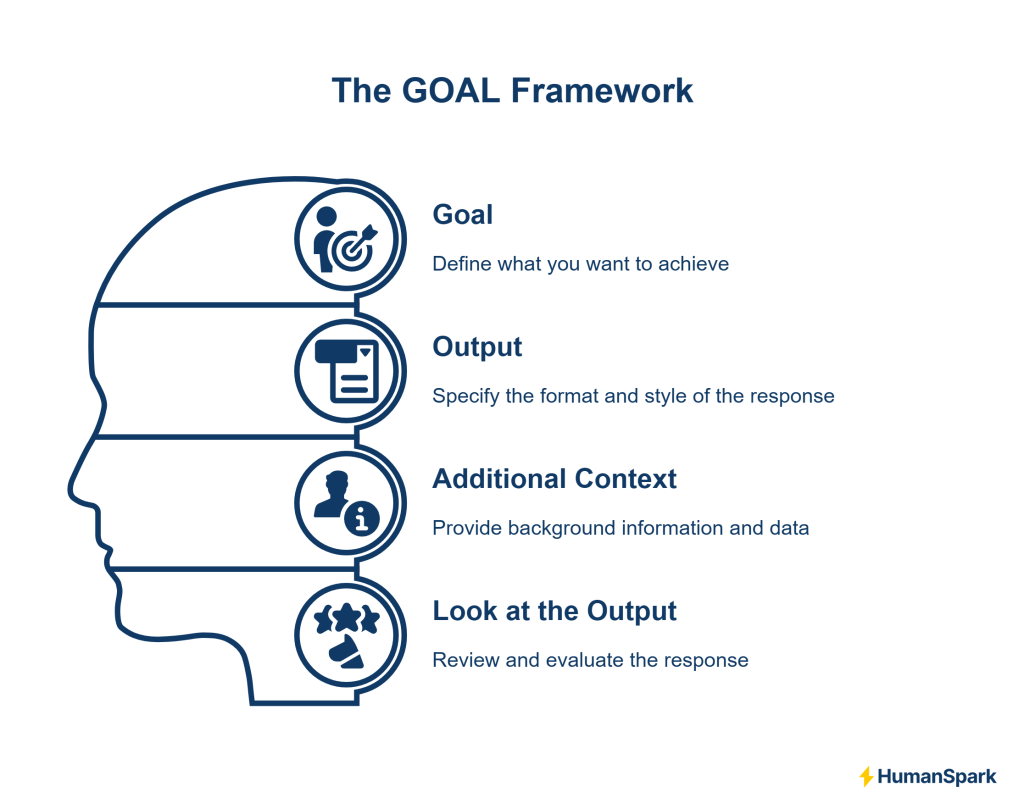
G: Goal
First things first, define what you want to achieve. Whether you’re looking for a detailed explanation, a creative idea, or a quick summary, having a clear goal is crucial. Be specific and detailed in your prompts to guide the model effectively.
- Define Your Goal: Clearly state what you want to achieve with your prompt.
- Be Specific: Ensure your goal is specific and detailed to get the best response.
- Clarify Desired Outcome: Describe the exact outcome you are looking for to guide the model effectively.
O: Output
Next, think about the format of the response you need. Do you want bullet points, a formal explanation, or a conversational reply? Specifying these details helps ChatGPT tailor the response to your needs.
- Specify Format: Indicate if you need the answer in a particular format, like bullet points or a summary.
- State Style: Mention if you want a specific style, such as formal or conversational.
- Indicate Length: Specify the length of the response you prefer, whether brief or detailed.
A: Additional Context
Context is key to getting relevant answers. Provide background information and any necessary data that the model might need to understand your query better. Examples can also help guide the model in producing the type of response you want.
- Provide Background Information: Always include relevant context in your prompts to help the model understand better.
- Include Necessary Data: Provide any data that the model might need to generate a comprehensive response.
- Use Examples: Give examples in your prompts to guide the model in producing the type of response you want.
L: Look at the Output
Finally, it’s crucial to review and evaluate the responses you get. Don’t just take the first response at face value. Check for accuracy, clarity, and completeness. Make sure the response addresses all parts of your question.
- Review for Accuracy: Always read through the responses to ensure they are accurate and relevant.
- Edit for Clarity: Refine the responses to correct any inaccuracies or improve clarity.
- Check Completeness: Ensure the response addresses all parts of your question or request.
GOAL Prompt Examples
1. Summarizing Research Findings
I need a summary of the key findings from a research paper on the current conditions in the consulting marketplace. The summary should be informative and concise, approximately 300 words. Highlight the main points regarding market growth, competitive landscape, and emerging trends.
2. Creating a Table
I need a table comparing the features of three different software tools used in enterprise environments: Tool A, Tool B, and Tool C. The table should be clear and concise with the following columns: Feature, Tool A, Tool B, Tool C. Key features to compare include user interface, scalability, integration capabilities, and support options.
3. Generating a CSV for Import into Excel or Google Sheets
I want to generate a CSV file with sales data for the first quarter of 2024. The columns should be Date, Product, Units Sold, and Revenue. The data should cover January, February, and March 2024 for three products: Product A, Product B, and Product C. Ensure the data is clean and ready for import into Excel or Google Sheets.
4. Writing a Business Report
I need a business report summarizing the performance of our marketing campaigns over the last quarter. The report should be clear and concise, approximately 700 words in length. Include an analysis of key metrics such as reach, engagement, conversion rates, and ROI. Provide recommendations for improving future campaigns based on the data.
5. Writing a Blog Post
I want to create a blog post about a particular approach to solving the issue of thermal expansion in bridge construction. Please write it at a 12th-grade reading level, in a conversational and engaging style, and approximately 500 words in length. Explain the problem of thermal expansion, why it’s significant, and how engineers can mitigate its effects using expansion joints.
By following the GOAL approach, you can make sure that your interactions with ChatGPT are productive and useful. Whether you’re using it for work, study, or fun, these tips will help you get the most out of this powerful tool. Happy prompting!