

My Workflow for Using AI Without Losing Authority
I use AI for a huge amount of my high-stakes professional writing now.
Not because it's smarter than me... ok, I mean, it is, but...
But it handles the parts of writing I find tedious while I focus on sharing my expertise and thinking accurately, with reasoning, and judgement.
- AI is brilliant at generating text and structure
- AI is brilliant at generating text and structure that looks correct
Large Language Models (LLMs) generate text.
They are prediction machines that generate the most plausible text they can, from the instructions (prompt) and input data (documents) you give them, combined with their training data.
That doesn't mean that all the text they generate is correct, just that it's plausible.
Many professionals avoid AI for serious documents because they worry about factual errors or losing credibility. I get it. But AI does not need to be accurate to be useful.
If you want to insist that AI is only useful if it's technically correct, go read "Why Accuracy Doesn't Always Matter".
Accuracy matters eventually. But it doesn't always matter first.
In the early stages - when you're staring at a blank page or trying to structure messy thoughts - progress beats precision.
What AI Does Well
AI speeds up the mechanical work so you can spend more time on what requires your brain.
AI doesn't have to be the Sunday roast. Sometimes it can be the microwave meal - quick, imperfect, but gets the job done when you're busy and under pressure.
For academic and business writing, that means using it as scaffolding.
It Gets You Past the Blank Page
Often the hardest part of writing is starting.
Ask it to brainstorm five different angles for your report. Generate a rough first draft of any section. Get it to review your existing text and suggest where the flow breaks down or where you're repeating yourself.
Even if you bin half of what it produces, you've made progress.
It Turns Chaos Into Structure
AI excels at finding patterns in messy information.
- Give it raw meeting transcripts and ask for a structured summary with decisions, action items, and key points.
- Feed it workshop recordings and get back executive summaries or handouts.
- Tools like Google NotebookLM can take your notes and turn them into mind maps or quizzes that help you actually understand complex material and visualise your work.
The bottleneck in professional writing is turning half-formed thoughts into coherent structure.
I used to spend hours organising workshop notes. Now it takes me ten minutes (and actually I'm reducing that further now).
One specific example: I used NotebookLM to process transcripts of 20 training workshops I ran, and turned them into a draft syllabus for an online course. I was then able to create an outline for each module of the course from that same input. A month's work done in half a day.
AI Helps Maintain Consistency Across Documents
Once you've got a structure that works, you can save it and reuse it.
- I build custom assistants (in ChatGPT or Gemini) preloaded with my preferred report format, tone, and structure. That way, every draft starts aligned with my standards instead of from scratch.
- I keep a spreadsheet of tested prompts for recurring tasks - reports, summaries, client briefs.
The Part You Can't Delegate to AI
Here's where the microwave meal isn't good enough.
For high-stakes work, you NEED the Sunday roast - properly prepared, checked, and served with care.
The mistake is expecting Sunday roast standards from the microwave - or worse, serving it as one.
Ok so how do you do this on a practical level?
Learn How to Use AI Properly
- Develop a curious, "Dora the Explorer" attitude. Experiment and learn.
- Hire me or someone like me to come in and teach you and your team how to use AI.
- If you want a structured starting point, my "Absolute Beginners Guide" will help.
My Process for Writing High Stakes Documents
When I'm working on high-stakes documents that must be correct, here's my process:
Step 1. Feed it my own materials first
I upload relevant documents like workshop transcripts, internal reports, past writing samples, or reference data. This gives the AI a reliable foundation instead of making things up from its training data.
Step 2. Get AI to build the outline or draft
I ask for outlines, section headings, and argument structure. Sometimes a full first draft. The goal is to see the document's structure quickly.
Step 3. Review everything with fresh eyes (and AI assistance)
Check every fact. Verify every quote. Confirm every number. Re-prompt or rewrite that section.
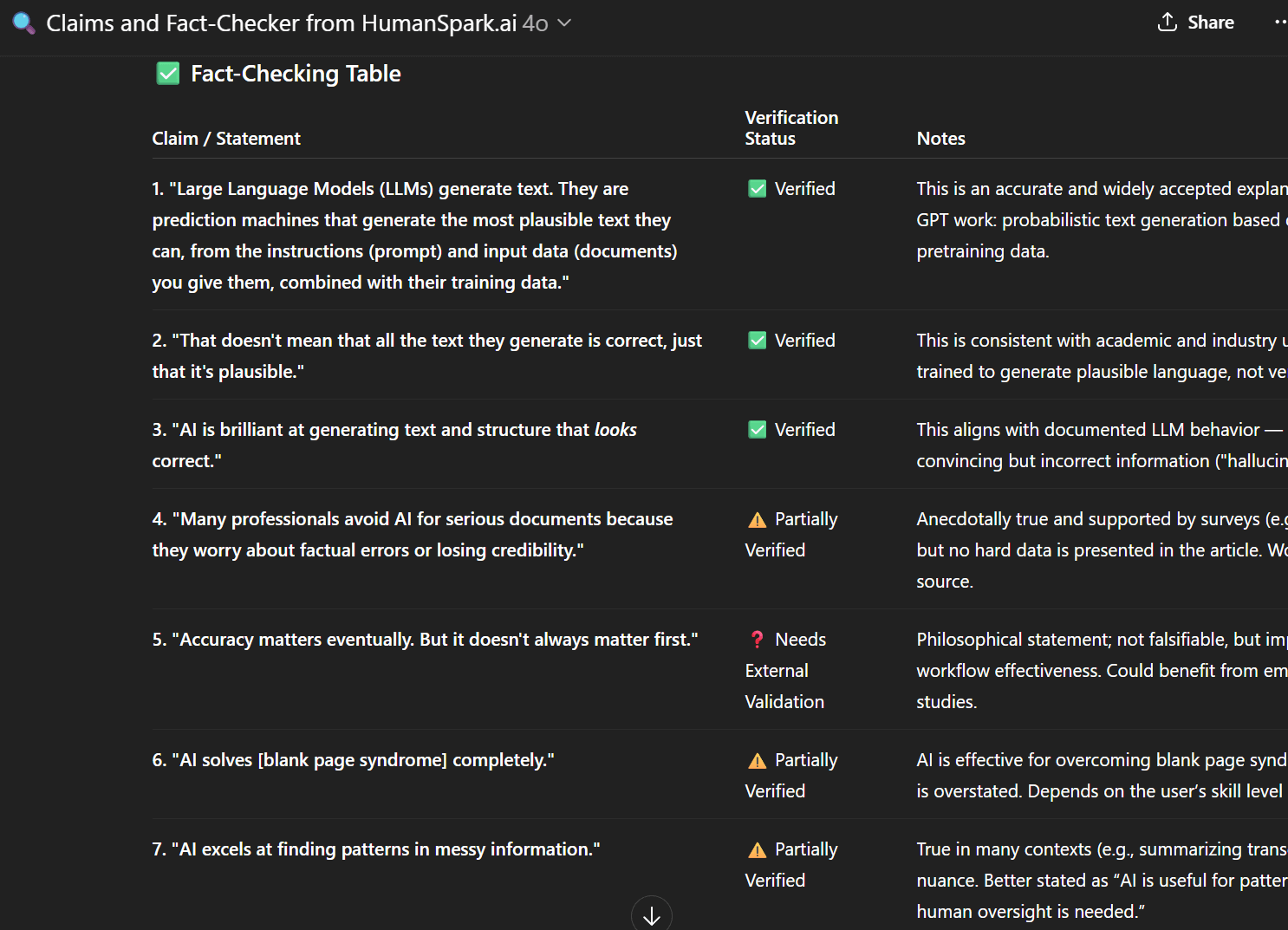
I even created a free AI fact-checker tool that you can use right now to help with this. Paste in your writing and ask it to review. Above shows the output - it lists all the claims you make in a document and helps you verify.
4. Save what works
I keep a prompt library for tasks I do regularly. Monthly reports, client summaries, research reviews. Each one has a tested prompt that produces consistent results.
5. Own the output
I sound like a broken record on this topic because I say it at least once a week:
Your work product is your work product.
Whether you handwrote it or used AI, the outcome is yours.
- Your professional reputation - and your company's reputation - live and die by the quality of your work product.
- It's absolutely fine to serve a microwave meal when appropriate. But let's not pretend it's Sunday lunch.
- Never publish something you haven't personally verified.
AI makes you faster. You still need to be the expert.
The Benefit
AI does not, and should not, replace your human judgement and expertise.
It does help you speed up your work, be more productive, and handles a lot of the time-consuming "grunt work".
When I write now, I spend less time staring at a blank page or reformatting bullet points.
I spend more time thinking about whether the argument makes sense, whether the data supports the conclusion, whether the writing is actually useful to the audience. (I hope you find that it is).
Treat it like a capable assistant who never gets tired but always needs supervision. Get it to handle the tedious structural work. You handle the judgement calls.
If you do this well, AI can become a multiplier of your output and authority.