
Anthropic just launched Claude Design yesterday.
Before I say what I think about the tool, I want to tell you about a story I read earlier in the week from BEFORE the launch.
The story came from a designer called Nurkhon, writing on Substack.
A product manager walked into a meeting, typed one sentence into Figma AI and thirty seconds later six complete interface screens appeared on the projector. The spacing made sense, the navigation worked, the team looked at the output and started planning a Thursday launch. (Figma is a traditional design tool that has added AI features.)
Nurkhon had spent nine days on the same project. His version was genuinely better as he had thought through the moments when a user might get stuck, written helpful error text that guided without patronising, considered the dozen edge cases the AI had glossed over. But nobody needed to compare the two versions.
His own summary is thus: "My nine days of craft had become invisible. Not because it wasn't good. Because craft was no longer the variable anyone was solving for." (You can read his full post here.)
Back to Claude Design.
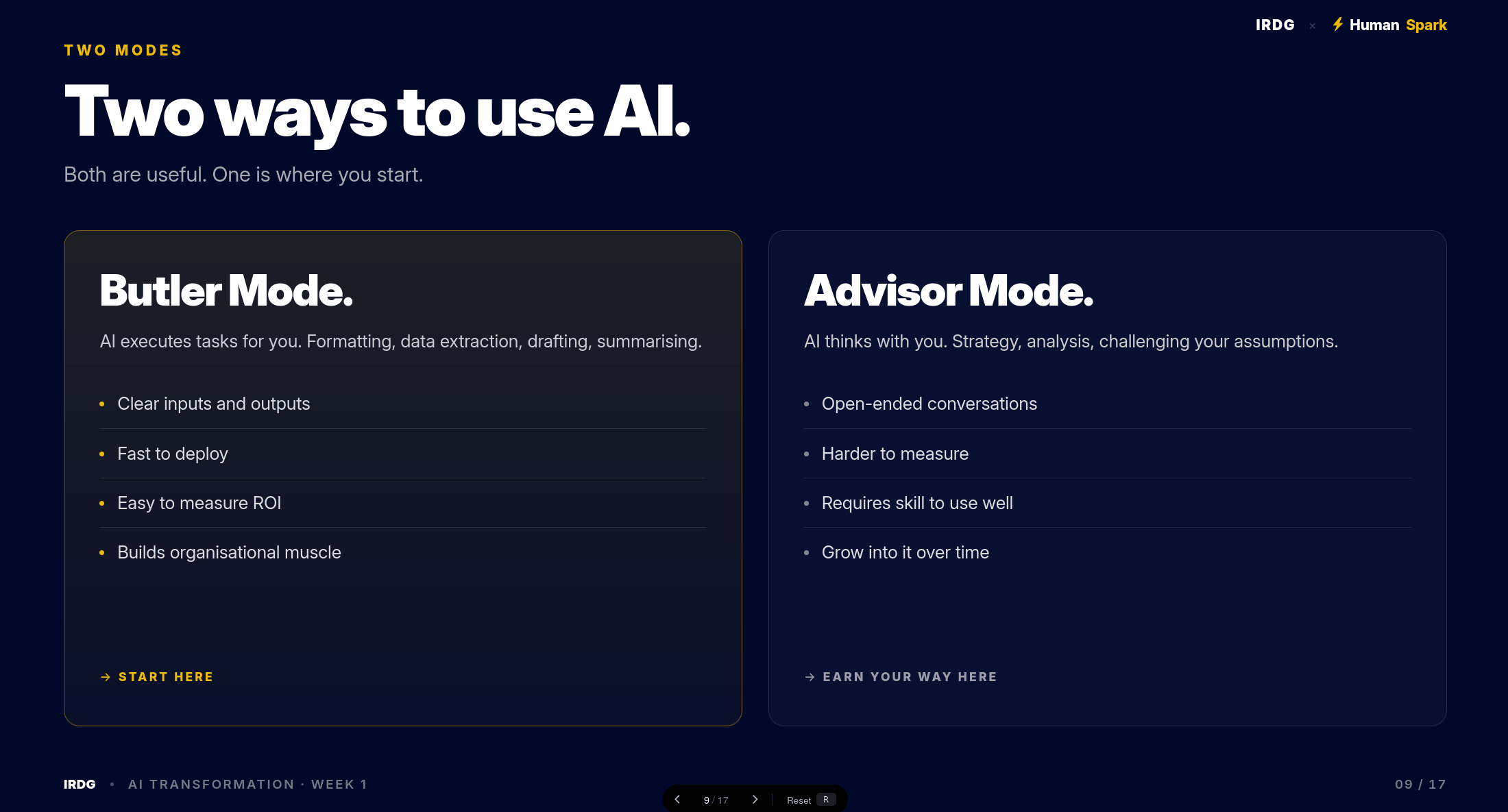
This is Anthropic's entry into the space where Google Stitch and a handful of others are already competing. You describe what you need, Claude builds a first version, and you refine through conversation, inline comments, or custom sliders. It is rolling out this week to subscribers on Pro, Max, Team, and Enterprise plans. The slide above was generated in ~20 seconds after I uploaded my style guide + slide text.
On the markets, Figma stock was down about 7% by yesterday's close, and Adobe fell too along with the rest of the design-software cohort. It had been a rough week at Figma before the launch - Anthropic's own Chief Product Officer, Mike Krieger (better known as the Instagram co-founder), had stepped off Figma's board earlier in the week, on the same day reports of Claude Design first leaked.
We have been watching this pattern play out all year. In February, when Anthropic shipped its Claude Cowork plugins for legal, finance, sales, and marketing work, Wall Street wiped roughly 285 billion dollars off SaaS stocks in a single 48-hour window. Thomson Reuters had its biggest one-day drop on record, LegalZoom lost nearly a fifth of its value, and RELX (the parent company of LexisNexis) had its worst session since 1988.
Analysts named the episode the SaaSpocalypse, and the rout has kept rolling through the spring.
Over a trillion dollars of software market capitalisation has evaporated from the sector since the start of the year.
If one AI agent can do the work of ten humans, the company that used to buy ten seats at 50 dollars a month now buys two.
The per-user, per-month pricing model that built two decades of SaaS wealth was always going to come under pressure once agents got good enough to draft a contract, run a financial audit, or generate a pitch deck.
Read Claude Design's launch announcement with Nurkhon's story fresh in your head, and both the news and the market reaction stop being a curiosity. They start describing what the next year of this work is going to look like. If you work in design, product management, or any role close to visual output, this is the week the ground shifted under your corner of it. Not in the breathless "AI will replace designers" way - Nurkhon's story already shows that reading is too simple. But in a way that changes the job itself.
Craft was no longer the variable
The lazy reading of Nurkhon's story is that AI beat the designer.
Craft was no longer what the team was trying to solve. They were trying to ship quickly. The thirty-second output was enough for that goal.
The nine days of thought Nurkhon had put into edge cases, error text, and navigation polish weren't ignored because the team failed to notice them, they were ignored because the team had moved on from the problem those nine days were solving.
The value of design work didn't disappear, what disappeared was the assumption that design variables like the edge cases, the error text, the navigation polish were still the variables worth investing in for this particular ship.
The PM had already decided:
What the team was solving for was momentum rather than quality.
The skill that matters now is reading which variable is being solved for.
It is not a harder version of craft skill, it is a different one. Knowing when nine days of polish is the right investment, and knowing when thirty seconds of "looks right, ship it" is the right call. Nurkhon knew how to build a beautiful interface. The question his story leaves open is whether he knew, on that project, that he was investing in the wrong variable.
What these tools cost
Generating a polished design system uses a lot of usage credits. If you run an agency and you want every designer on maximum-tier subscriptions with extra credits for the complex days, your software bill climbs quickly.
The common framing is "AI saves you hours." The less common follow-up is "and here's what it costs in tokens, subscriptions, and rework." Both of those are true, and the ROI conversation I am having with clients now is much more careful than the one I was having in early 2025. You only find out which one wins for your specific workflow after you have integrated the tool into a live project.
My advice to every client this month is the same: pick one real project, build the initial wireframes with Claude Design or an equivalent, and track actual credit consumption against hours saved. You will learn more about whether this tool fits your business in one week than you will learn from any amount of vendor marketing.
Designing screens is ten percent of the job
Drawing the interface is a small fraction of a designer's work. The other ninety percent is talking to users, understanding business constraints, and figuring out what should be built in the first place. None of the AI design tools do that work - not Claude Design, not Google Stitch, not anything on the horizon - because that work requires sitting in a room (or on a call) with a human being and asking the right questions about the problem they are trying to solve.
The production part is getting commoditised while the direction part is becoming more valuable. If your career strategy is built on speed in Figma or Adobe XD, you have a problem. If it is built on user research, problem framing, and knowing which of the six AI-generated screens is the one that should ship, you are in a much better spot than you were a year ago.
What to do next week
Some practical options, if you want to stay ahead of this.
- Generate a complex interface using Claude Design. Then, in five minutes, write two short lists: what the output solved for well, and what it skipped entirely. You are training the eye that decides whether the thing the AI has shipped is the thing your project actually needs.
- Audit one project against real token costs rather than the vendor pitch, so you know whether the tool pays for itself in your specific workflow.
- Shift the weight of your learning budget from software skills to research skills. User interviews, problem framing, business context, strategic thinking about what to build - that is the work AI has barely started on.
Nurkhon's eye - the one that knows when thirty seconds is enough and when nine days is the right investment - is a specific, teachable skill.
Looking at your own current projects, which phase do you think is most ready to hand to a tool like Claude Design, and which part would you absolutely not trust to it yet?
I set out three positions in using AI, directing it, or running it. What stays yours in that shift is your judgement.